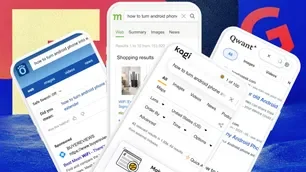
Google's AI Overviews, which now appear at the top of roughly 60% of English-language search results in 2026, have made finding actual source links harder than it has been in over a decade. The Gemini 3.7 Flash-powered summaries are often accurate and genuinely useful, but they've also trained a generation of searchers to accept an AI's interpretation of the web rather than evaluating sources themselves - and for anyone who does research, fact-checking, or just wants to read the original article, the experience has become genuinely frustrating. After three months of testing alternatives on my Pixel 11 Pro, here are nine search engines that still show you links, ranked by how well they handle the post-AI-Overview reality. DuckDuckGo remains the best privacy-first option. Its 2026 redesign, which added a cleaner mobile interface and the new DuckDuckGo AI Chat that lets you query multiple models including Claude and ChatGPT without leaking your data, is the strongest it's ever been. It doesn't inject AI Overviews into standard results, which means you see actual links - and the new video player that blocks YouTube ads is a genuine bonus. Perplexity is the best AI-augmented option for users who want both. It generates an AI summary, but crucially cites every claim with inline source links, so you can verify and click through to the original. The free tier handles most queries, and the Pro tier at $20/month gives access to Gemini 3.0 Ultra and Claude for more complex research. Brave Search, with its independent index and the new Brave GPT integration, is excellent for technical queries. Kagi, the paid search engine at $10/month, is the best premium option - it has no ads, no AI Overviews by default, and a genuinely superior ranking algorithm that prioritizes content quality over engagement metrics. Startpage, which proxies Google results without tracking, is the best option for users who want Google's relevance without Google's surveillance. Searx, the self-hosted meta-search engine, is the choice for privacy maximalists who want to aggregate results from dozens of engines. Mojeek, with its fully independent crawler, is the best option for users who want to support a non-Google index. You.com, with its AI agent focus, is the best for multi-step research workflows. And Wikipedia's internal search, often overlooked, remains the best starting point for factual research. The common thread across all nine: they respect the link as the fundamental unit of the web, rather than replacing it with an AI's interpretation. In 2026, that's becoming a rare and valuable stance.
Tired of AI Overviews? I found 9 Google Search alternatives like DuckDuckGo and Perplexity that show links again
FutureTech